Technical Details
How refrigerators work
All refrigeration cycles work much the same way. They compress a gas, which heats it and increases its pressure. It is then cooled and then expanded, which reduces its pressure and temperature. A reverse cycle system takes the heat from the compressed gas and uses it for heating. The cooled gas is then warmed using heat from an outside source.
In conventional refrigeration cycles a refrigerant is used, which is a vapour at low pressure but becomes liquid when compressed and cooled. The liquid is then expanded through a nozzle where again becomes a vapour and its pressure and temperature is reduced.
The Miser cycle, called the Bell-Coleman cycle, does not use a refrigerant. Instead, it performs thermodynamic cycles on the actual air that is being heated or cooled. In heating cycle, air is expanded, which reduces its pressure and temperature, then warmed in a ground sourced heat exchanger, then compressed back to atmospheric pressure which increases its temperature. In cooling cycle, air is compressed, which increases its temperature and pressure, then cooled in a
ground sources heat exchanger, then expanded back to atmospheric pressure which reduces its temperature.
First use of the Bell-Coleman cycle
The Bell-Coleman cycle was first used in 1877 for the ocean transport of meat. However, it was replaced early in the 20th century when the modern vapour compression cycle was invented. Today the cycle is primarily used in air conditioning of aircraft and in liquefaction of LPG.
There were four main reasons the Bell-Coleman cycle was replaced:
- Machinery was large and cumbersome because a large volume of air had to be treated to get a significant cooling effect. The Miser overcomes this problem by using a gerotor which is able to tread a large volume of air with a relatively small machine. It uses the same space over and over again.
- The efficiency of the systems varied very much, depending on the environment it is working in. The Miser overcomes this problem by sensing its environment and adjusting settings to be optimal. When a conditioned space is very hot or very cold, performance is optimised over efficiency and when the space is close to target temperature efficiency is optimised.
- In some circumstances snow is formed inside the machine. When first used this was a problem because it would block valves. The Miser does not use valves. Instead, it has large open ports and uses centrifugal force to expel the snow.
- Friction was significant because of the large size of machinery and the use of traditional sealing devices. The Miser overcomes this by having very few contacting parts and maintaining very small gaps between matching surfaces. Components are machined to a high
level of accuracy.
Coefficient of Performance (COP)
COP is the measure of the efficiency of a refrigeration cycle, which can be used for heating or cooling. The COP is the ratio of heating or cooling effect compared with the power used. The COP of an electric fan heater, for example, is 1 because the heat produced is equal to the energy used. A reverse cycle refrigeration system produces more heat than the energy used because, instead of producing heat outright, it upgrades the temperature of heat sourced from outside. A typical COP of a conventional reverse cycle air conditioning system is 3 – 5. A similar calculation determines the COP in cooling cycle.
The Miser COP is never below 8 but is usually in the range of 18 – 25 depending on the conditions it is working in and how hard it is being worked. When a conditioned space is very hot or very cold air is passed through a ground sourced heat exchanger before being introduced into the Miser. It that case the effective COP can be 40 or more.
How the Miser works
The miser uses a gerotor to perform the thermodynamic processes on the air. This ensures that a relatively small machine can treat a large volume of air.
The rotors are made of rigid PVC and they do not touch. There is a constant gap of about 0.2 mm between them which greatly reduces the friction.
The Miser has both a heating cycle and a cooling cycle. In the heating cycle air is drawn in and expanded, which reduces its pressure and temperature. The temperature is usually in the 10C to – 10C range. It is then passed through a ground sourced heat exchanger which warms it to approximately 16C. It is still at the low pressure and it is fed into the compression chamber, which is also a gerotor, where it is compressed back to atmospheric pressure and in the process gets heated.
The compression and expansion gerotors are close coupled and energy is constantly being transferred between the two.
In the cooling cycle air is first compressed then cooled and then expanded.
Construction of the Miser
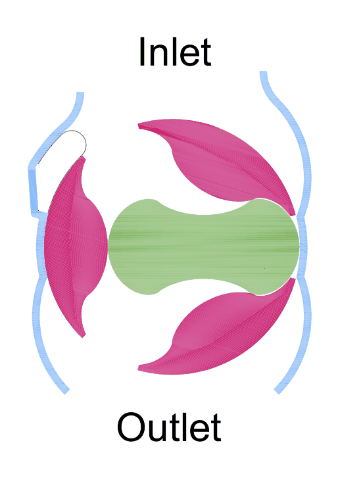
The Miser has 2 main chambers, the compression chamber and the expansion chamber. Both chambers are spaces between 2 lobed rotors, the inner rotor and the outer rotor, working together, shown in the adjacent animation. The animation is a section taken through the expansion chamber.
The red items are the outer rotor, the gap between them representing the inlet / outlet ports. The green item is the inner rotor rotating at an offset centre and at 50% faster speed. The compression chamber works in a similar way.
The compression and expansion outer rotors are close coupled, as are the inner rotors. This means that force applied to the outer rotor in one chamber is automatically transferred to the other. Similarly for the inner rotors.
This is a longitudinal sectional view of the Miser. 3 dimensional views of the various components can be seen in the patent held at the US patents office.
Adjusting for maximum COP
The Miser uses two different adjustments to maximise COP in varying situations, the mass of air ingested in each cycle and the relative volume of compression chamber and expansion chamber. The microprocessor calculates the optimum combination of these settings and makes the adjustment. In the current design the volume of the expansion chamber is varied and the volume of the compression
chamber is fixed. The mass of air ingested is controlled by a sliding port.
Adjusting for maximum COP or performance
The Miser uses two different adjustments to adjust COP in varying situations, the mass of air ingested in each cycle and the relative volume of compression chamber and expansion chamber. The microprocessor calculates the optimum combination of these settings and makes the adjustment. In the current design the volume of the expansion chamber is varied and the volume of the compression
chamber is fixed. The mass of air ingested is controlled by a sliding port.